We are your trusted health partner. Local doorstep deliveries is within the hour .We are Licensed and Regulated by the Pharmacist's Council of Nigeria(PCN).Prices displayed here may differ due to inflation.
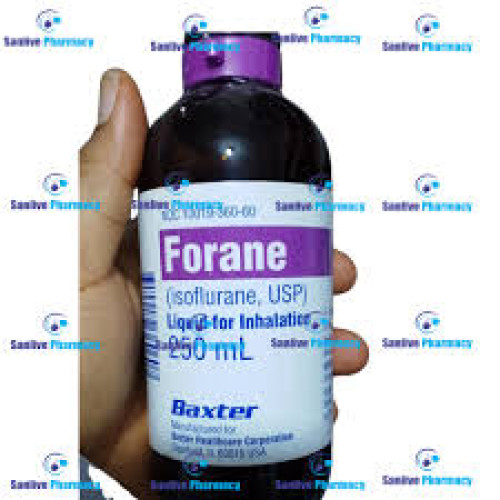
Forane is a prescription-only, high-potency volatile general anesthetic. It contains pure Isoflurane as a clear, colorless liquid packed in a 250ml heavy amber glass bottle.
It is used exclusively inside operating theaters to induce and maintain general anesthesia (putting a patient to sleep) during major surgical procedures.
Forane does not work like an injection; it is inhaled into the lungs to act directly on the brain’s primary electrical switches:
Vaporizer Delivery: The liquid is poured directly into a dedicated, color-coded (purple) Forane vaporizer attached to an anesthesia machine. The machine converts the liquid into a precise percentage of gas mixed with oxygen.
Depresses the Central Nervous System: Once inhaled, the gas passes instantly from the lung sacs into the blood and travels straight to the brain. It stabilizes and dampens nerve cells by altering cell membranes and boosting inhibitory brain signals.
Induces Deep Unconsciousness: This action rapidly brings about deep unconsciousness, a complete lack of pain sensation (analgesia), temporary loss of memory (amnesia), and structural relaxation of the body's skeletal muscles so surgery can take place safely.
Induction of General Anesthesia: Smoothly transitioning a patient from consciousness into a deep surgical sleep (more commonly used for maintenance rather than induction due to its mildly pungent odor).
Maintenance of General Anesthesia: Keeping a patient safely and steadily asleep throughout short or multi-hour surgical operations across all ages.
Because volatile anesthetics heavily depress your breathing, blood pressure, and core muscle metabolism, medical teams track the following severe risks:
Malignant Hyperthermia (MH) Alert: Forane is strictly prohibited if the patient or a blood relative has a known history of Malignant Hyperthermia. This is a rare, inherited, life-threatening crisis where volatile gases trigger a massive, uncontrolled spike in muscle metabolism, leading to extreme body temperatures ($>42^{\circ}\text{C}$), rapid muscle breakdown, and heart failure.
Severe Cardiovascular Depressant: It causes widespread widening of blood vessels (vasodilation), which standardly leads to a direct drop in blood pressure (hypotension) and a compensatory rise in heart rate.
Increased Brain Pressure: Use with extreme caution in patients with a head injury or raised intracranial pressure, as it increases blood flow to the brain.
To protect both the surgical patient and the theater staff from accidental exposure, precise operating protocols are maintained:
The Color-Coded Law: Forane liquid must only be poured into the purple-coded isoflurane vaporizer. Vaporizers are strictly keyed so that no other anesthetic gas (like yellow Sevoflurane) can be mixed into it accidentally.
Scavenging Systems: Operating rooms must utilize advanced gas scavenging systems to vacuum up exhaled breath traces, preventing the surgical team from experiencing accidental drowsiness or long-term gas exposure.
Dose Calibration (MAC): The anesthesiologist constantly fine-tunes the gas percentage based on the patient's Minimum Alveolar Concentration (MAC), adjusting the depth of sleep minute-by-minute in response to changes in blood pressure and heart rate.
1.Charge the purple-coded vaporizer with liquid:Vaporizer Filling.
The theater nurse uses a safety-keyed bottle adaptor to pour the clear Forane liquid directly into the purple isoflurane vaporizer chamber on the anesthesia machine.
2.Induction and mechanical airway placement:Airway Securement.
The patient is typically put to sleep first with a brief IV injection (like Propofol), and an endotracheal breathing tube is placed to safely secure their airway.
3.Turn on the Forane gas dial to 1% - 2.5%:Gas Maintenance.
The gas dial is turned on. Forane vapor is mixed smoothly with oxygen and run continuously into the breathing circuit to keep the patient deeply and safely asleep.
4.Turn off the vaporizer and flush with pure oxygen:The Wake-Up Phase.
As the surgeon places the final skin sutures, the anesthesiologist cuts off the gas flow completely. The patient breathes out the remaining vapors and naturally wakes up within 5 to 15 minutes.
As the anesthetic gas completely clears out of your lungs and brain cells in the recovery room, patients may experience:
Shivering and Tremors: Shivering violently upon waking up (post-operative shivering) is a highly common reaction to volatile gases as the body resets its internal temperature clock.
Moderate nausea, vomiting, or a localized sore throat caused by the breathing tube.
Feeling temporarily confused, lightheaded, or unusually emotional early on in the recovery bay.
Why is Forane rarely used to put patients to sleep via a mask while they are awake?
Unlike Sevoflurane, which has a sweet, completely pleasant smell, Forane has a mildly pungent, irritating odor. If an awake patient tries to breathe it in deeply via a mask, it can cause them to hold their breath, cough violently, or experience a spasm of the vocal cords (laryngospasm). Because of this, anesthesiologists prefer to put patients to sleep using an IV drug first, and then use Forane to keep them asleep.
What is the antidote for a Malignant Hyperthermia crisis caused by Forane?
If a patient develops the sudden muscle rigidity, rapid heart rate, and skyrocketing temperature of Malignant Hyperthermia, the anesthesiologist will immediately shut off the Forane gas, flush the machine with 100% pure oxygen, and rapidly inject the specific life-saving antidote: Dantrolene Sodium Intravenous.
How should a 250ml bottle of Forane be stored before use?
Keep your heavy amber glass bottles stored upright in a cool, well-ventilated drug room, strictly below $30^{\circ}\text{C}$ and away from direct sunlight. Ensure the cap is screwed on tightly, as the liquid evaporates rapidly at room temperature if exposed to open air.
Due to its classification as a highly restricted critical care anesthetic agent, volatile liquids require absolute supply chain integrity and authenticated manufacturing parameters to prevent catastrophic surgical failures or dangerous operating room contamination. Institutional hospital procurement, emergency theater stock replenishment, and validated batch tracking can be securely coordinated via Sanlive Pharmacy & Stores for rapid, tamper-evident delivery directly to registered surgical centers, teaching hospitals, and accredited private operating clinics within Lagos, Abuja, Port Harcourt, and nationwide via our verified hospital logistics channels.
Important Notice: This information is for educational and institutional procurement support purposes only. Forane (Isoflurane) is an ultra-high-potency surgical agent. All clinical calculations, delivery setups, and general anesthesia maintenance must be executed exclusively under the direct, physical supervision of a registered Consultant Anesthesiologist. If a patient shows an unexplained rise in resting heart rate, severe jaw muscle rigidity, or an explosive spike in exhaled carbon dioxide levels during surgery, activate the emergency Malignant Hyperthermia crisis protocol immediately.
No reviews yet — be the first!
Log in to write a review.



 150mg.jpg)