We are your trusted health partner. Local doorstep deliveries is within the hour .We are Licensed and Regulated by the Pharmacist's Council of Nigeria(PCN).Prices displayed here may differ due to inflation.
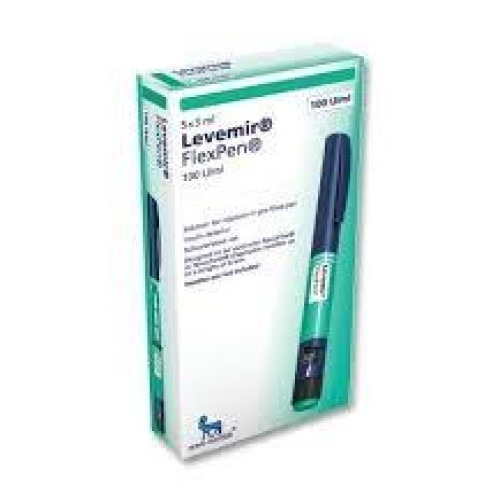
Levemir is a prescription-only, high-potency long-acting basal insulin analogue. It contains Insulin Detemir and is supplied as a multi-dose pre-filled disposable injection pen (FlexPen).
It has a standard concentration of 100 U/mL (Units per milliliter), with each 3mL pen containing 300 units of insulin. It is administered via a Subcutaneous (S.C.) injection once or twice daily by adults, adolescents, and children aged 1 year and older to establish flat, steady glycemic control in both Type 1 and Type 2 Diabetes Mellitus.
Traditional long-acting insulins can sometimes cause erratic blood sugar drops. Levemir achieves a smooth, extended absorption profile through a specialized molecular configuration:
The Fatty Acid Chain Alteration: The insulin detemir molecule is modified by attaching a 14-carbon fatty acid chain (myristic acid) to one of its amino acid positions.
Reversible Albumin Binding: Once injected subcutaneously under the skin tissue, this fatty acid tail causes the insulin molecules to self-associate and bind reversibly to albumin, the primary transport protein in the blood.
The Peakless 24-Hour Release: The insulin slowly and continuously unbinds from albumin at a highly uniform rate. This creates a flat background supply of active insulin over up to 24 hours, functioning without a sharp or volatile peak. This steady design helps lower your biological risk of unexpected low blood sugar crashes, particularly during nighttime hours (nocturnal hypoglycemia).
Diabetes Mellitus (Type 1 & Type 2): Long-term baseline (basal) insulin coverage to manage fasting plasma glucose levels. In Type 1 Diabetes, Levemir must always be paired with a fast-acting mealtime insulin (like NovoRapid or Humalog) to cover post-meal blood sugar spikes.
Active Hypoglycemia: Strictly contraindicated during any active episode of low blood sugar.
Thiazolidinedione (TZD) Interactions: If paired with oral diabetes tablets called TZDs (such as pioglitazone/Actos), monitor closely for signs of heart failure. Combining insulin with TZDs can cause severe fluid retention and heart strain.
Hypokalemia Susceptibility: Insulin drives potassium from the blood into cells, which can drop your blood potassium parameters. Use with extra monitoring if you take high-dose water pills or suffer from kidney issues.
Pregnancy and Breastfeeding: Levemir is widely studied and considered safe for use during pregnancy and nursing under close medical observation. Dosage parameters typically decrease during the first trimester and rise during the second and third trimesters.
The Once or Twice-Daily Protocol: Depending on your metabolic profile, your physician will prescribe Levemir once daily (taken with your evening meal or at bedtime) or twice daily (spaced evenly 12 hours apart, such as with breakfast and dinner) to maintain stable baseline levels.
The Subcutaneous Site Rule: Inject strictly into the fat layer right under the skin—standardly in the abdomen, thigh, or upper outer arm. Never inject Levemir into a vein or a muscle, as this causes the insulin to absorb immediately, triggering a critical, dangerous blood sugar crash.
Meticulous Site Rotation: Rotate your injection spot within your chosen area with every single dose. Do not inject into skin that is tender, bruised, hard, or scarred, as this prevents lipodystrophy (pits or fat lumps forming under the skin).
Zero Dosing Conversions: The dose counter window on the FlexPen always displays the exact number of units you need to inject. Simply turn the dial to your prescribed unit number.
1.Verify your insulin label and attach a fresh needle:Pen Preparation.
Wash your hands. Check the pen label to verify it says "Levemir" and ensure the fluid inside the glass reservoir window is completely clear, colorless, and free of floating particles. Screw on a fresh, sterile disposable needle (such as a NovoFine needle).
2.Perform a brief 2-unit flow check:Priming (Flow Check).
Turn the dose selector dial to exactly 2 units. Hold the pen upright with the needle pointing up and tap the reservoir gently. Press the injection button completely in. A drop of insulin must appear at the needle tip to clear trapped air bubbles and guarantee an accurate dose.
3.Dial your exact unit dose, insert, and hold for 6 seconds:Delivery Mechanics.
Turn the dial until the window displays your exact prescribed dose number. Clean your skin site with alcohol, pinch the skin slightly, and insert the needle straight down at a 90-degree angle. Press and hold the injection button completely down until the dial window snaps back to 0. Keep the needle held deep in the skin for a full 6 seconds before withdrawing to ensure the full dose has left the pen matrix.
4.Remove the used needle immediately and replace the cap:Safe Storage.
Carefully unscrew the used needle and discard it into a puncture-proof sharps bin. Never store the pen with a needle attached, as this causes insulin to leak out or lets air and bacteria seep inside. Pop the pen cap back on.
As your metabolic pathways adjust to the basal insulin profile, you may notice typical clinical updates:
Hypoglycemia (Low Blood Sugar): The most common side effect. Learn to recognize the warning signs: sudden dizziness, sweating, shakiness, confusion, a rapid heart rate, intense hunger, or blurred vision. Always carry a fast-acting sugar source (such as glucose tablets, fruit juice, or honey) to treat sudden drops immediately.
Minor localized injection site updates, including temporary redness, mild swelling, itching, or minor bruising.
Lipodystrophy (changes in skin thickness or texture if you fail to rotate your daily injection sites properly).
Mild systemic updates, including minor fluid retention (peripheral edema) causing slight swelling in the hands or ankles, along with temporary mild weight gain early on.
What should I do if I accidentally miss a daily Levemir dose?
If you realize you have missed a dose, look at your schedule. If you take Levemir once daily and your next regular dose is not due for several hours, take the missed dose immediately and return to your regular cycle. If you take it twice daily, consult your physician for advice before altering your cycle. Never inject a double dose to catch up for a forgotten day.
Can I mix Levemir in the same syringe with other insulins?
No, absolutely not. Levemir must strictly never be mixed with any other insulin type or solution. Mixing it with other fluids alters its chemical pH, destroying the reversible albumin-binding mechanism and completely neutralizing its long-acting baseline properties.
How must the Levemir FlexPen be stored safely?
Unused Pens: Keep your unopened Levemir pens stored securely inside the refrigerator between 2°C and 8°C. Never freeze them. If a pen accidentally freezes, discard it immediately.
In-Use Pens: Once you use a pen for the first time, you can keep it at cool room temperature strictly below 30°C or inside the refrigerator for up to 6 weeks (42 days). Keep the pen cap on when not in use to protect the clear insulin matrix from direct sunlight, and keep it completely out of the sight and reach of children.
Advanced, long-acting basal insulin analogues are highly temperature-sensitive and require strict cold-chain infrastructure to prevent the degradation of the delicate protein structures. To eliminate the high global risks of counterfeit, expired, or improperly stored biologics, Levemir requires rigid supply chain auditing and continuous cold-chain tracking ($2^{\circ}\text{C}$ to $8^{\circ}\text{C}$) from the manufacturer to the patient. Hospital procurement teams, metabolic health clinics, and individual diabetic patients can securely submit prescriptions and buy genuine, factory-authenticated Levemir FlexPens (manufactured by Novo Nordisk, NAFDAC Reg. No. 04-7901) online through Sanlive Pharmacy & Stores for verified payment and rapid, cold-chain validated distribution directly to your home, office, or clinical suite within Lagos, Abuja, Port Harcourt, and nationwide via our trusted specialty clinical logistics networks.
Important Notice: This information is for educational and procurement support purposes only. Levemir is a high-potency, prescription-only basal biologic medication. Your entire therapeutic layout, dosage adjustments, and routine metabolic metrics (including fasting blood glucose tracking and HbA1c monitoring) must be managed under the direct physical direction of a registered Endocrinologist, Diabetologist, or Physician. If a patient experiences severe un-responsive hypoglycemia leading to confusion or a loss of consciousness, experiences signs of an active systemic anaphylactic reaction, or develops deep rapid breathing, administer emergency glucagon or activate immediate emergency medical resuscitation protocols at a hospital straight away.
No reviews yet — be the first!
Log in to write a review.

.jpg)