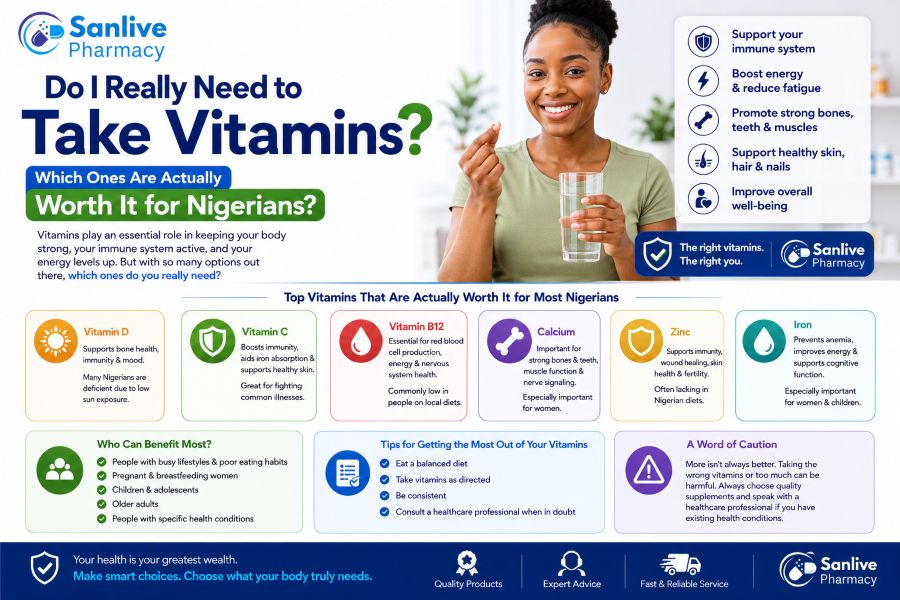
Do I Really Need to Take Vitamins? Which Ones Are Actually Worth It for Nigerians?
The supplement market is full of products making big promises. Here is what the science says, what Nigerians actually need, and what is just expensive marketing.
Walk into any pharmacy in Nigeria and you will see shelves full of vitamins, supplements, and health boosters — Vitamin C, Vitamin D, Zinc, Multivitamins, B-Complex, Omega-3, and dozens more. Every brand promises to make you healthier, stronger, or more energetic. But do you actually need all of these? Or is it mostly just clever advertising?
The honest answer is: some vitamins are genuinely important for Nigerians to supplement, especially given our typical diet and lifestyle. Others are mostly unnecessary if you eat reasonably well. This post will tell you which is which — in plain language, without jargon.
Quick Answer
The vitamins most Nigerians genuinely benefit from: Vitamin D (most Nigerians are deficient despite the sunshine), Folic acid (essential for pregnant women and women of childbearing age), Iron (especially for women and children), Vitamin C (especially if your diet is low in fruits), and a basic Multivitamin if your diet is not well-balanced.
First: Can't I Just Get All My Vitamins from Food?
In theory, yes. A well-balanced diet should give you most of the vitamins and minerals your body needs. Traditional Nigerian food — beans, leafy vegetables like ugwu and spinach, tomatoes, plantain, eggs, fish, and fruits — is actually quite nutritious.
But in practice, several factors mean many Nigerians are not getting enough of certain nutrients:
- Busy urban lifestyles that rely on fast food, processed food, or skipping meals
- Cooking methods that destroy vitamins (prolonged boiling destroys much of the Vitamin C in vegetables)
- Not eating enough variety — many households eat the same foods repeatedly
- Certain life stages that massively increase your needs — pregnancy, breastfeeding, childhood, old age
- Medical conditions or medications that reduce absorption of certain nutrients
Vitamin D — Surprisingly, Many Nigerians Are Deficient
This surprises many people. Nigeria is close to the equator and gets abundant sunshine. So how can Nigerians be Vitamin D deficient?
The answer is that Vitamin D is produced when your skin is directly exposed to sunlight — but most urban Nigerians spend the majority of their day indoors (in offices, cars, and air-conditioned spaces), use sunscreen (which blocks Vitamin D production), or wear clothing that covers most of their skin. Studies on Nigerian populations have found surprisingly high rates of Vitamin D deficiency.
Vitamin D is essential for: strong bones and teeth, a healthy immune system, muscle function, and mental wellbeing. Low Vitamin D has been linked to frequent infections, bone pain, fatigue, and depression.
Who especially needs it: Office workers, people who wear hijab or full-body clothing, exclusively breastfed babies, elderly people, and people with darker skin tones (who need more sun exposure to produce the same amount of Vitamin D).
Folic Acid — Non-Negotiable for Women Who Want to Get Pregnant
Folic acid (also called Vitamin B9) is the one supplement that every woman planning to get pregnant must take — and ideally, every woman of childbearing age. It is not a nice-to-have. It is critical.
Folic acid prevents a group of serious birth defects called neural tube defects, which affect the baby's brain and spine. The problem is that these defects happen in the first 4 weeks of pregnancy — often before a woman even knows she is pregnant. This is why doctors recommend starting folic acid at least 1 month before you try to conceive, and continuing through the first 3 months of pregnancy.
The recommended dose is 400 micrograms (0.4mg) daily for most women, or 5mg daily for women with a history of neural tube defects or certain medical conditions. You can find folic acid and other women's reproductive health supplements in our Reproductive Solutions for Women section.
Iron — Critical for Women, Children, and Anyone Who Feels Constantly Tired
Iron deficiency is one of the most common nutritional deficiencies in Nigeria, especially in women of childbearing age (because of blood loss during periods), pregnant women, children under 5, and people who do not eat much meat or fish.
Signs that you may be low in iron include: feeling very tired all the time, looking pale, getting breathless easily, frequent headaches, dizziness, and cold hands and feet. This condition is called anaemia.
However — do not just buy iron tablets and start taking them without testing first. Excess iron in the body is toxic and can cause serious problems. A simple blood test (full blood count) will tell you if you are actually anaemic and need iron supplements. If you are, our Blood Enrichment and Iron-Rich Elixirs section has a range of iron supplements in tablet and liquid form.
Vitamin C — Important, But You Probably Need Less Than You Think
Vitamin C is one of the most popular supplements in Nigeria. Many people take it daily hoping it will prevent colds, boost immunity, and keep their skin glowing. Here is the honest picture:
- Vitamin C genuinely supports the immune system and is important for healing, skin health, and iron absorption
- If your diet regularly includes tomatoes, fresh peppers, oranges, and vegetables, you are probably getting enough
- Taking very high doses (like 1000mg daily) does not prevent colds — but it may slightly shorten their duration
- The excess is simply excreted in your urine — so massive doses are mostly wasted money
- The recommended daily intake for adults is 65–90mg — a single medium orange gives you about 70mg
That said, if your diet is low in fresh fruits and vegetables, a basic 500mg Vitamin C supplement is inexpensive and a reasonable choice. Browse our full range in the Immune Boosters section.
Multivitamins — When Do They Make Sense?
A multivitamin is a combination of multiple vitamins and minerals in a single tablet or capsule. They are a convenient "insurance policy" for nutritional gaps in your diet. They are worth considering if:
- You frequently skip meals or have a very restricted diet
- You are elderly and your appetite has reduced
- You are a picky eater or your children are
- You are pregnant or breastfeeding (look specifically for a prenatal multivitamin)
- You are recovering from a serious illness or surgery
A multivitamin will not replace a poor diet, and it will not make you more energetic if you are already eating well. But for people with genuine nutritional gaps, it is a convenient and affordable way to fill them. Browse our Multivitamins section and our Supplements section for a wide range of options.
What About the Expensive "Wellness" and "Energy" Supplements?
The supplement market is full of products that promise extraordinary results — weight loss, muscle gain, sexual enhancement, anti-aging. Here is a practical guide to how to think about these:
- If the claim sounds too good to be true, it probably is. No supplement can "melt fat while you sleep" or "add 5 inches."
- Stick to supplements that have well-established research behind them (like the ones discussed in this article)
- Look for NAFDAC registration numbers on the pack — if a supplement does not have one, it has not been assessed for safety in Nigeria
- Ask our pharmacist before spending money on an expensive supplement — we will give you an honest answer
For legitimate, NAFDAC-approved supplement options, browse our General Wellness and Supplements sections.
Shop Genuine Vitamins and Supplements
All products are NAFDAC-approved. Our pharmacists can help you choose what you actually need.
Shop Multivitamins Ask Our Pharmacist
❓ My child is not eating well. Should I give vitamin syrup?
A multivitamin syrup can be a good safety net for children who are picky eaters or going through a phase of reduced appetite. But do not use it as a substitute for teaching good eating habits. Focus first on offering a variety of real foods. If you are concerned your child has a serious deficiency, a paediatrician can arrange blood tests. Browse our Infant Wellness products for child-specific vitamins.
❓ I am pregnant. What vitamins must I take?
At minimum: folic acid (400mcg–5mg daily, started before conception if possible), iron (as recommended by your doctor based on your blood test), and Vitamin D. A good prenatal multivitamin covers most of these in one tablet. Check with your doctor or our pharmacist to make sure your supplement covers what you need for pregnancy in Nigeria.
❓ Can taking too many vitamins harm you?
Yes. Fat-soluble vitamins — Vitamins A, D, E, and K — are stored in the body and can build up to toxic levels if you take too much over time. Vitamin A toxicity, for example, can cause liver damage and birth defects. Water-soluble vitamins (B vitamins and Vitamin C) are safer in higher doses because excess is excreted, but very high doses can still cause problems. Take vitamins at the recommended dose — more is not always better.
⚕️ Disclaimer: This article is for educational purposes only and does not constitute medical advice. Nutritional needs vary based on age, health status, and individual circumstances. Consult a registered pharmacist or doctor before starting any supplement regimen, especially during pregnancy, breastfeeding, or if you have a medical condition.

.jpg)