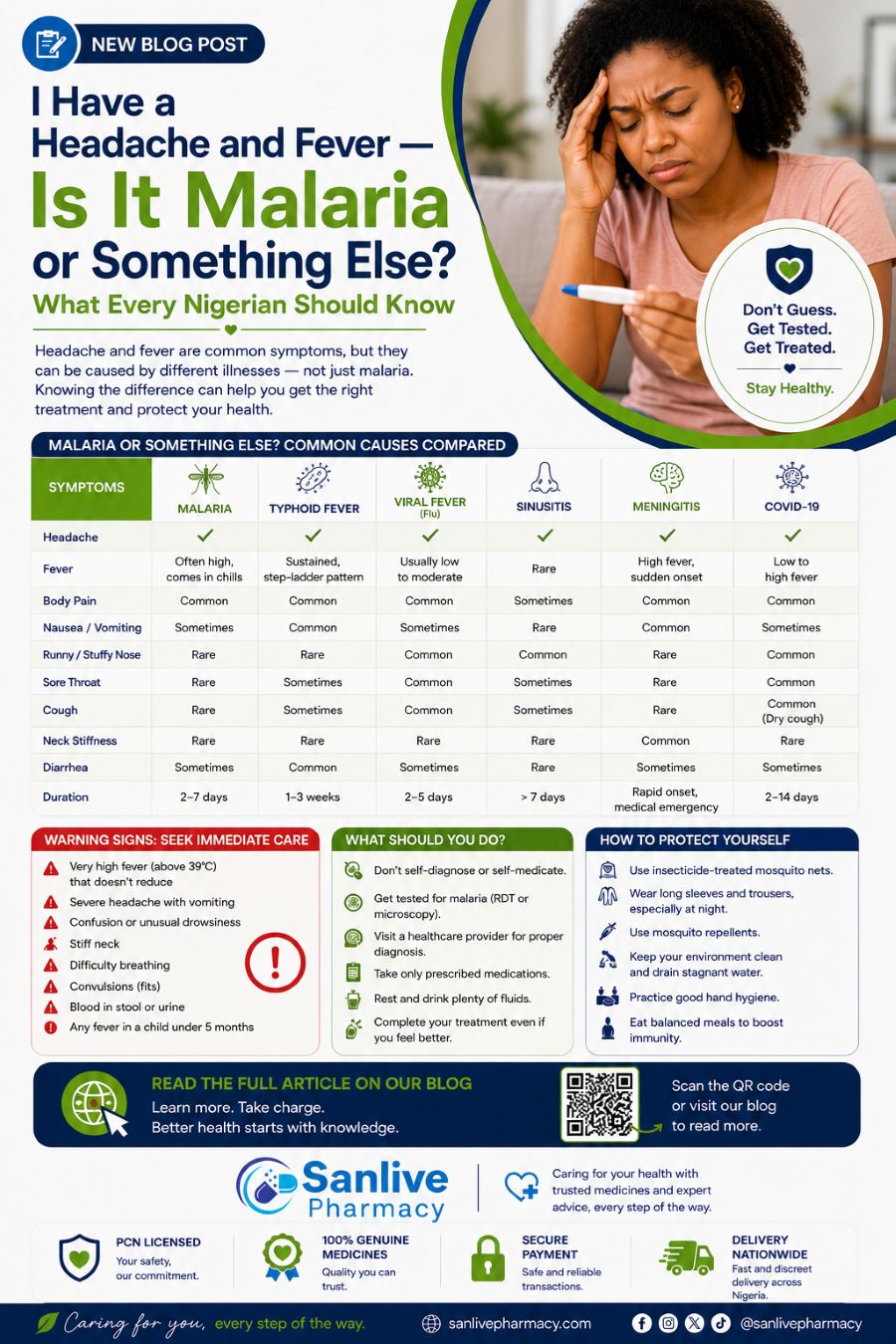
I Have a Headache and Fever — Is It Malaria or Something Else? What Every Nigerian Should Know
You wake up feeling hot. Your body is aching. You have a throbbing headache and feel very weak. The first thing most Nigerians think is: "I have malaria." But is it really malaria? And if it is, what should you take?
This guide answers that question plainly — explaining what malaria actually is, what the symptoms look like, how to tell it apart from typhoid and other infections, and what genuine antimalarial medicines are available in Nigeria today — so you can make a smart, safe decision for yourself and your family.
Quick answer: Fever plus headache plus body pain plus chills plus sweating equals possible malaria. But these symptoms also match typhoid, flu, and other infections. The safest thing to do is test first, then treat. If you cannot test, speak with a SanLive pharmacist before buying any medication.
What Is Malaria and How Do You Get It?
Malaria is a disease caused by a tiny parasite called Plasmodium. You get it when a female Anopheles mosquito bites you and passes the parasite into your blood. Nigeria accounts for approximately 27 percent of all malaria cases in the world — meaning if you are Nigerian, you have likely had malaria before or know someone who has.
The parasite gets into your red blood cells, destroys them, and causes all the symptoms you feel. Left untreated, malaria can become severe and affect your brain, kidneys, and liver. Children and pregnant women are the most at risk of serious complications.
What Are the Real Symptoms of Malaria?
Malaria symptoms usually appear 7 to 14 days after you are bitten by an infected mosquito. Here is what to look for:
- Fever — body temperature above 38°C (100.4°F)
- Chills and shaking — you feel very cold and start shivering even when the weather is hot
- Sweating — after the chills, you sweat heavily
- Headache — a pounding headache that does not go away easily
- Body pain and weakness — your joints and muscles ache
- Nausea and vomiting — you feel like throwing up or actually vomit
- Tiredness — you feel too weak to do anything
These symptoms come and go in cycles — you might feel okay for a few hours and then the fever returns. This cycling pattern is a key sign that points specifically to malaria and distinguishes it from many other illnesses.
How Is Malaria Different from Typhoid?
Many Nigerians confuse malaria and typhoid because they share similar symptoms. Here are the important differences:
| Symptom | Malaria | Typhoid |
|---|---|---|
| Fever pattern | Comes and goes in cycles | Builds up slowly over days |
| Headache | Severe, throbbing | Dull, persistent |
| Stomach pain | Rare | Common |
| Rose-coloured rash | No | Sometimes yes |
| Chills and shaking | Very common | Less common |
| How you get it | Mosquito bite | Contaminated food or water |
The bottom line is do not guess. A simple malaria rapid diagnostic test (RDT) takes less than 20 minutes and tells you exactly what you are dealing with — saving you from taking the wrong medication.
✅ Browse malaria rapid test kits on SanLive Pharmacy — test at home with confidence, delivered across Nigeria and internationally within 3 to 4 days.
What Antimalarial Drugs Are Available in Nigeria?
If your test confirms malaria, start treatment immediately. Here are the most trusted antimalarial medications available in Nigeria today — all NAFDAC-approved and available on SanLive Pharmacy.
1. Artemether-Lumefantrine (Coartem, Lonart) — First-Line Treatment
This is the most recommended first-line treatment for uncomplicated malaria in Nigeria by the Federal Ministry of Health. It works by killing the malaria parasite at different stages of its lifecycle. It is taken twice daily for 3 days and must always be taken with food or a fatty drink like milk — fat helps the body absorb it properly.
✅ Order Artemether-Lumefantrine (Coartem/Lonart) on SanLive Pharmacy — genuine, NAFDAC-approved, delivered across Nigeria and internationally within 3 to 4 days.
2. Artesunate-Amodiaquine (Camosunate, Coarsucam)
Another highly effective combination used to treat uncomplicated malaria. Also taken for 3 days. This is a good alternative for people who have had side effects from Coartem previously.
✅ Order Artesunate-Amodiaquine on SanLive Pharmacy — verified and delivered discreetly to your door across Nigeria and internationally.
3. Dihydroartemisinin-Piperaquine (Duo-Cotecxin)
A good option for people who need an alternative to the above combinations. Taken once daily for 3 days — a dosing schedule many people find easier to remember and stick to.
✅ Order Dihydroartemisinin-Piperaquine (Duo-Cotecxin) on SanLive Pharmacy — delivered across Nigeria and internationally within 3 to 4 days.
4. Artesunate Injection — For Severe Malaria Only
If malaria becomes severe — meaning it affects the brain, causes seizures, or the person cannot swallow tablets — artesunate injection is given in a hospital. This should never be handled at home. If someone has severe malaria, go to the nearest hospital immediately.
⚠️ Critical Warning: Do Not Use Chloroquine or Fansidar as Main Treatment
Do not take chloroquine or SP (Fansidar) as the main treatment for malaria in Nigeria. The malaria parasite in Nigeria has become resistant to these older drugs and they frequently do not work. Stick exclusively to the artemisinin-based combination therapies (ACTs) listed above. If you are unsure what to take, speak with a SanLive pharmacist before purchasing.
Antimalarial Drug Comparison Table
| Drug | Brand Names | How Taken | Duration | Best For |
|---|---|---|---|---|
| Artemether-Lumefantrine | Coartem, Lonart | Twice daily with fatty food | 3 days | First-line uncomplicated malaria |
| Artesunate-Amodiaquine | Camosunate, Coarsucam | Once or twice daily | 3 days | Alternative to Coartem |
| Dihydroartemisinin-Piperaquine | Duo-Cotecxin | Once daily | 3 days | Simplified dosing alternative |
| Artesunate Injection | Hospital only | IV or IM injection | Hospital-determined | Severe malaria only |
Can I Buy Antimalarial Drugs Online in Nigeria?
Yes — but only from a licensed, verified pharmacy. Counterfeit and fake antimalarial drugs are a serious problem in Nigeria. Fake artemisinin-based drugs look identical to genuine ones but contain little or no active ingredient, meaning malaria is not treated and the parasite continues to multiply.
SanLive Pharmacy is a PCN-licensed, NAFDAC-compliant online pharmacy. All our antimalarial medications are genuine, sourced directly from verified manufacturers, and delivered safely to your door — in Lagos with fast delivery, or nationwide and internationally within 3 to 4 days.
✅ Browse all antimalarial medications on SanLive Pharmacy — never risk a counterfeit when treating malaria.
How Do You Prevent Malaria?
Treatment is important, but prevention is even better. Here are the most practical steps every Nigerian family should take:
Sleep under an insecticide-treated mosquito net every night — this single intervention reduces malaria transmission dramatically. Use mosquito repellents including sprays, coils, or plug-in devices. Eliminate standing water around your home, since mosquitoes breed in stagnant water. Use window and door screens to keep mosquitoes out. If you are pregnant, talk to your doctor about preventive malaria medication during pregnancy (IPTp). If you are travelling to a high-malaria area, ask about preventive medication before you travel.
✅ Browse mosquito repellents and household hygiene support products on SanLive Pharmacy — protect your family before malaria strikes.
Nigerians in the Diaspora — You Can Order Too
If you are a Nigerian living in the UK, USA, Canada, Australia, Europe, or the Middle East and need access to genuine antimalarial medications or malaria rapid test kits, SanLive Pharmacy ships internationally.
- Delivery time: 3 to 4 days to most international destinations
- Packaging: Plain, discreet, and unbranded
- Support: Speak with a SanLive pharmacist for personalised guidance on dosing, treatment duration, and which drug is right for you
Whether you are in London, Houston, Toronto, Dubai, or Melbourne — order your antimalarial medication from SanLive Pharmacy and receive it within 3 to 4 days.
Frequently Asked Questions
Can malaria kill you? Yes, severe malaria can be fatal — especially in young children, pregnant women, and people with weakened immune systems. This is why early treatment within 24 hours of symptoms appearing is so important. Do not wait days before getting treatment. Order your antimalarial medication immediately from SanLive Pharmacy if your test is positive.
Can I give an adult dose of Coartem to a child? No. The dose of Coartem and other antimalarials depends on body weight. Children need a much smaller dose than adults. Always check the dosing table on the pack or speak with a SanLive pharmacist to confirm the correct dose for your child's weight before administering.
What should I eat while taking malaria medicine? Eat food with every dose — especially fatty food like milk, pap with milk, or any meal with oil. This is especially important for Coartem (artemether-lumefantrine) because the drug needs dietary fat to be properly absorbed into your body. Taking it on an empty stomach significantly reduces its effectiveness.
How do I know if my malaria is getting better? Fever and chills should begin to improve within 24 to 48 hours of starting treatment. You should feel significantly better by Day 3. If symptoms worsen, if fever continues beyond 48 hours of treatment, or if you become confused or cannot swallow, seek emergency medical care immediately — these are signs of severe malaria.
Is it safe to treat malaria at home? Uncomplicated malaria in adults can be safely managed at home with the correct ACT medication, adequate hydration, rest, and paracetamol for fever. However, malaria in children under 5, pregnant women, elderly patients, and anyone showing signs of severe malaria must be evaluated and treated by a healthcare professional. If in doubt, speak with a SanLive pharmacist first.
What is the difference between a malaria RDT and a blood test? A malaria rapid diagnostic test (RDT) detects malaria antigens in a finger-prick blood sample and gives a result in 15 to 20 minutes. It is highly accurate for detecting the most common and dangerous species, Plasmodium falciparum. A laboratory blood film or PCR test is more comprehensive and can identify the malaria species precisely — useful for complicated or treatment-resistant cases. For most straightforward cases in Nigeria, an RDT is sufficient to confirm or rule out malaria before treatment.
Can diaspora Nigerians order antimalarial drugs from SanLive Pharmacy? Yes. SanLive Pharmacy ships to the UK, USA, Canada, Australia, Europe, and the Middle East with delivery in 3 to 4 days in plain, discreet packaging.
The Bottom Line
Malaria is extremely common in Nigeria — but it is also entirely treatable when diagnosed correctly and treated promptly with the right medication. Do not guess based on symptoms alone, do not take outdated drugs like chloroquine, and do not buy antimalarials from unverified sources. Test first. Treat with genuine ACT medication. Start within 24 hours of a positive result. And when in doubt, speak with a pharmacist before spending money on the wrong treatment.
- 🔵 Browse all antimalarial medications on SanLive Pharmacy
- 🔵 Order Artemether-Lumefantrine (Coartem/Lonart)
- 🔵 Order Artesunate-Amodiaquine (Camosunate)
- 🔵 Order Dihydroartemisinin-Piperaquine (Duo-Cotecxin)
- 🔵 Order Malaria Rapid Test Kits
- 🔵 Browse Mosquito Repellents and Prevention Products
- 🔵 Speak with a SanLive Pharmacist for Free
This article is for educational purposes only and does not replace the advice of a qualified healthcare professional. Always consult a registered pharmacist or doctor before starting any medication — especially for children, pregnant women, or people with other health conditions. SanLive Pharmacy operates in compliance with NAFDAC regulations and international pharmaceutical standards.


.jpg)